History
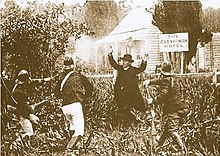
Les frères Lumière released the first projection with the Cinematograph, in Paris on 28 December 1895. The French film industry in the late 19th century and early 20th century was the world's most important. Auguste and Louis Lumière invented the cinématographe and their L'Arrivée d'un train en gare de La Ciotat in Paris in 1895 is considered by many historians as the official birth of cinematography. The first feature film to be made was the 1906 Australian silent The Story of the Kelly Gang, an account of the notorious gang led by Ned Kelly that was directed and produced by the Melburnians Dan Barry and Charles Tait. It ran, continuously, for eighty minutes.
In the early 1910s, the film industry had fully emerged with D.W. Griffith's The Birth of a Nation. Also in the early 1900s motion picture production companies from New York and New Jersey started moving to California because of the good weather and longer days. Although electric lights existed at that time, none were powerful enough to adequately expose film; the best source of illumination for movie production was natural sunlight. Besides the moderate, dry climate, they were also drawn to the state because of its open spaces and wide variety of natural scenery.
Hollywoodedit
The first movie studio in Hollywood area, Nestor Studios, was founded in 1911 by Al Christie for David Horsley. Other East Coast studios had already moved production to Los Angeles. Over time, Hollywood came to be so strongly associated with the film industry that the word "Hollywood" is now used colloquially to refer to the entire American film industry.
In 1913 Cecil B. DeMille, in association with Jesse Lasky, leased a barn with studio facilities in Hollywood where The Squaw Man (1914) was made. It is now the location of the Hollywood Heritage Museum.
The Charlie Chaplin Studios were built in 1917. The site was also used by Kling Studios, for the Superman TV series; Red Skelton, who used the sound stages for his CBS TV variety show; and CBS, which filmed the TV series Perry Mason there. It has also been owned by Herb Alpert's A&M Records and Tijuana Brass Enterprises. It is currently The Jim Henson Company, home of the Muppets. In 1969 The Los Angeles Cultural Heritage Board named it a historical cultural monument.
The noted Hollywood Sign originally read "Hollywoodland." It was erected in 1923 to advertise a new housing development in the hills above Hollywood. In 1949 the Hollywood Chamber of Commerce stepped in and removed the last four letters and repaired the others. It is a registered trademark and cannot be used without the permission of the Hollywood Chamber of Commerce.
The first Academy Awards presentation ceremony took place on May 16, 1929.
The period between the years 1927 (the effective end of the silent era) to 1948 is considered the age of the "Hollywood studio system", or the Golden Age of Hollywood. In a landmark 1948 court decision, the Supreme Court ruled that movie studios could not own theaters and play only the movies of their studio and movie stars; thus an era of Hollywood history ended.
Bollywoodedit
Bollywood is the Hindi-language film industry based in Mumbai (formerly known as Bombay), Maharashtra, India. The term is often incorrectly used to refer to the whole of Indian cinema; however, it is only a part of the total Indian film industry, which includes other production centres producing films in multiple languages. Bollywood is the largest film producer in India and one of the largest centres of film production in the world.
Bollywood is formally referred to as Hindi cinema. Linguistically, Bollywood films tend to use vernacular Hindustani, mutually intelligible to self-identified speakers of both Hindi and Urdu, while modern Bollywood films also increasingly incorporate elements of Hinglish.
The Wrestlers (1899) and The Man and His Monkeys (1899), directed and produced by Harischandra Sakharam Bhatawdekar (H. S. Bhatavdekar), were the first two films made by Indian filmmakers, which were both short films. He was also the first Indian filmmaker to direct and produce the first documentary and news related film, titled The Landing of Sir M.M. Bhownuggree.
The 1930s and 1940s were tumultuous times: India was buffeted by the Great Depression, World War II, the Indian independence movement, and the violence of the Partition. Most Bollywood films were unabashedly escapist, but there were also a number of filmmakers who tackled tough social issues, or used the struggle for Indian independence as a backdrop for their plots.
In 1937 Ardeshir Irani, of Alam Ara fame, made the first colour film in Hindi, Kisan Kanya. The next year, he made another colour film, a version of Mother India.
Following India's independence, the period from the late 1940s to the early 1960s is regarded by film historians as the "Golden Age" of Hindi cinema. Defining key figures during this time included Raj Kapoor, Guru Dutt, Mehboob Khan, and Dilip Kumar.
The 1970s was when the name "Bollywood" was coined, and when the quintessential conventions of commercial Bollywood films were established. Key to this was the emergence of the masala film genre, which combines elements of multiple genres (action, comedy, romance, drama, melodrama, musical). The masala film was pioneered in the early 1970s by filmmaker Nasir Hussain, along with screenwriter duo Salim–Javed, pioneering the Bollywood blockbuster format.
Comments
Post a Comment